The Department of Rehabilitation Medicine (DRM) is the only rehabilitation center in the country equipped with complete and comprehensive services to meet the dynamic needs of patients with disabilities. From its humble beginnings in 1971, the department has evolved into a multidisciplinary center that truly promotes quality of life in patient management while being at the forefront of research and training in physical medicine and rehabilitation. Using the combined expertise of multiple health professionals, comprehensive care is delivered through an individualized, goal-oriented approach in the management of acute and chronic medical and surgical conditions that may have detrimental effects on an individual.
The department boasts of an array of basic and state of the art rehabilitation services, reaching all patients in the spectrum of their lifespan and almost all types of diseases. Its specialized programs, such as Cardiac Rehabilitation, Pain and Arthritis Care, Geriatric Rehabilitation, Pediatric Rehabilitation, Neurorehabilitation, Burn Rehabilitation and Telerehabilitation, among others, ensure that patients and their families are provided with optimum care. Special diagnostic procedures such as electrodiagnostic studies (EMG & NCV), musculoskeletal ultrasound (MSK US), the Walking Assistance Learning Unit (WALK Unit), the Motion Analysis Program in partnership with the Department of Orthopedics, as well as advanced management such as the Robotic Lower Extremity Gait Training, are available for patient care as well as for training purposes .
The department has further established itself as the premier training institution of Rehabilitation Medicine in the Philippines which includes residency and fellowship programs as well as paramedical training programs. The department remains committed to teaching the undergraduate medical students of the College of Medicine through its involvement from Learning Units 4 to 7. It has maintained its competitive edge in the annual specialty board examinations and in multiple research fora. Its emphasis on continuing education for its trainees and allied medical professionals is reflective of its desire to maintain its standards.
The department also lends its expertise in improving policy, patient safety, and streamlining of patient services through its partnerships both within and outside the hospital. There are regular activities from community-based rehabilitation engagement, in cooperation with UP Pahinungod, as well as wheelchair and prosthesis missions, conducted in partnership with Physicians for Peace and other non-government organizations to provide access of the needed device to PWDs. The Department is also a regular participant in the activities and advocacies of the Philippine Academy of Rehabilitation Medicine. Aside from these, there is also ongoing collaboration between the Philippine Health Insurance Corporation and the department to guide the creation of the Rehabilitation Packages to benefit those in need.
The PGH Department of Rehabilitation Medicine continues to set the standard of excellence as the model disciplinary center in preventive, primary and rehabilitative care of the differently abled, and looks forward to its continued growth and development through its commitment to provide the best quality care for its patients, in the hope of a return to functional and fulfilling lives.
Vision
We envision ourselves as a multidisciplinary state-of-the art institution setting the standards of excellence for rehabilitation as part of the continuum of healthcare delivery.
Mission
We commit ourselves to train efficient, competent, compassionate Physical and Rehabilitation Medicine professionals and provide holistic services to all Filipinos, especially the underserved.
VALUES
Responsiveness
Excellence
Holistic
Advancement
Benebolence
HISTORY
The Department of Rehabilitation Medicine (DRM) at the Philippine General Hospital (PGH) traces its origins to 1910, initially operating under the Radiology Department and offering physical therapy modalities. It was then recognized as a department in 1971, after which a three-year residency training program was established. The department also expanded to include Speech Therapy, Psychology, and Social Services on top of the ongoing Physical Therapy and Occupational Therapy services. Rehabilitation Medicine was then also included in the curriculum of the College of Medicine. Through the pioneering efforts of Dr. Guillermo Damian and Dr. Antonio Periquet, Rehabilitation Medicine evolved into a leading specialty. The department also maintained close ties with the School of Allied Medical Professions (now the College of Allied Medical Professions), with Dr. Damian as its first dean.
By 1980, DRM launched its first Community-Based Rehabilitation (CBR) program, earning national recognition. Specialty clinics soon developed such as the Stroke Clinic, Electrodiagnostic Medicine, Cardiac Rehabilitation, the Burn Clinic, Prosthetics & Orthotics, and Pediatric Rehabilitation. Eventually, a Special Education (SPED) unit for early childhood intervention services was also established.
Along with the continued expansion of the hospital in the early 1980s, the department soon transferred to the area where it is today, now as a 16-bed capacity rehabilitation ward. The residency training program continued to grow, producing an increasing number of graduates.
Strategic partnerships further strengthened the department's impact on service delivery, and training. Since the late 1980s, the department has been in partnership with the Employees’ Compensation Commission, providing service to the injured workers. In 2001, through the Philippine Foundation for the Reintegration of the Disabled, the Prosthetics and Orthotics workshop was renovated. In 2006, the Walking Free Project with Physicians for Peace provided low-cost prostheses, leading to the establishment of the Walking Assistance and Learning Key (WALK) Unit and the Amputee Ward in 2008. Its collaboration with the Department of Orthopedics, which established the Gait Motion Analysis Laboratory, in partnership with Marquette University in 2014, provided another venue for learning and service. In 2014, the department also applied for PhilHealth accreditation, being one with its mission to serve the underserved Filipino nation.
Telerehabilitation services were also introduced, initially in Alfonso, Cavite, and later expanded, preparing the department for broader telemedicine applications. This was also utilized in the training of the medical students from Learning Units 5 to 7.
In 2019, the Musculoskeletal Rehabilitation Medicine Fellowship Training Program was created as a result of a decade of provision of musculoskeletal ultrasound diagnostic and interventional pain management services.
As PGH became a COVID-19 referral center during the pandemic, DRM services were temporarily suspended and staff were reassigned to COVID and non-COVID wards to support the nation. The necessary lockdown prevented face-to-face consultations, especially from those in far-flung areas. In response, the department launched ITAWAG (Introducing Telerehabilitation As a Way to Access General Rehabilitation Services), enabling remote consultations. As the hospital electronic medical records and bed zoning minimized exposure risks, education continued through online learning and virtual residency training to ensure continuity. The Mental Health Check Initiative on Facebook also provided psychological support during the pandemic as well.
As technology advanced, DRM integrated innovative rehabilitation methods. Its acquisition of a robotic gait trainer enhanced rehabilitation of patients with various neurologic conditions.
Innovation and continuous development through research has always been a cornerstone of DRM, with special Acta Medica Philippina journal issues showcasing significant rehabilitation research, ensuring that patient care remains evidence-based and up-to-date.
Now past its 50th year, DRM has moved towards strengthening its multi-disciplinary collaborations resulting to various multidisciplinary programs, such as, Neuromuscular Disease Clinic, Osteogenesis Imperfecta Clinic, Down Syndrome Clinic, Fracture Liaison Service, Enhanced Recovery After Surgery Pathway, Comprehensive Ambulatory Respiratory Rehabilitation Program, and the Collaborative Cardiac Rehabilitation, have been developed, with Critical Care Rehabilitation which has just been recently established. The call for selfless service and nation-building, through the Community-Based Rehabilitation in Buguias, Benguet, was made possible by the establishment of ties with the Pahinungod.
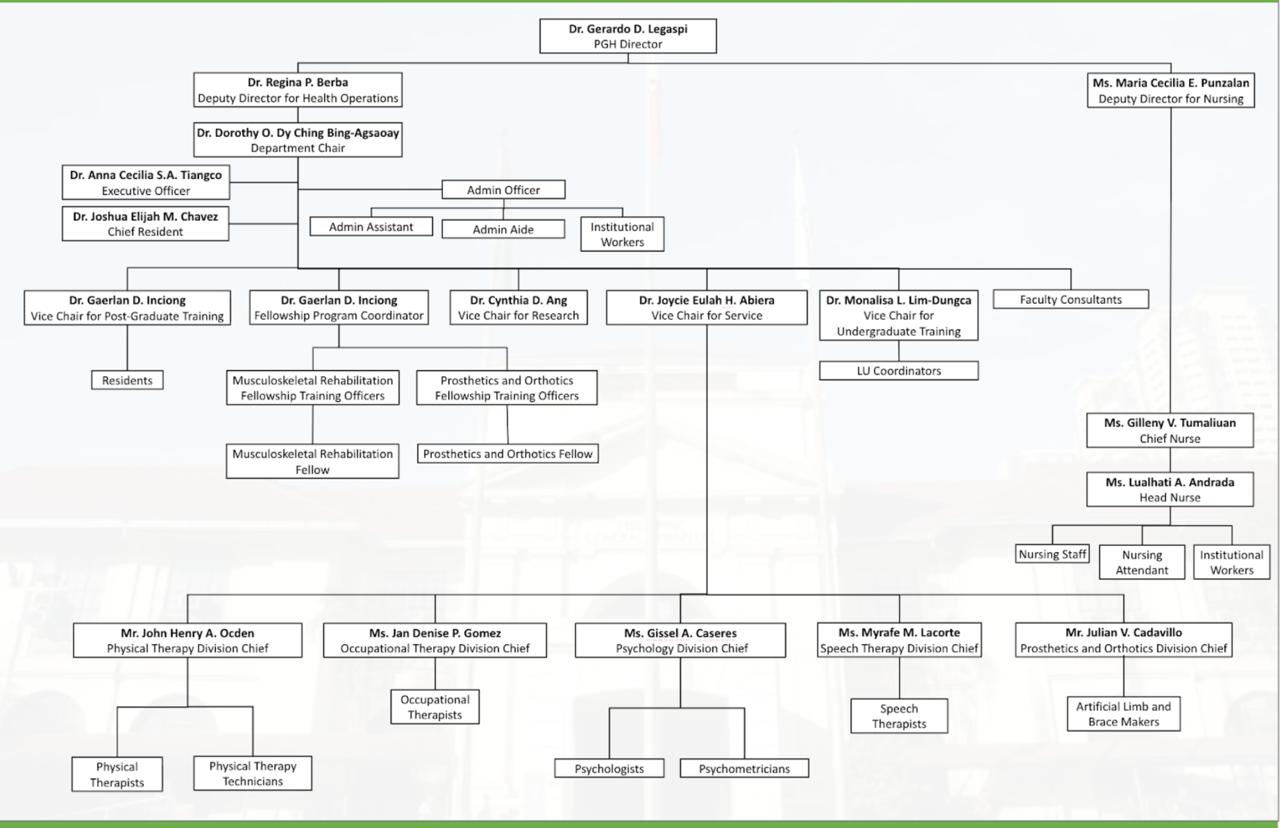
From its humble beginnings, consisting only of the sections of physical therapy and occupational therapy, and the whole department being manned only by one consultant, one resident, one nurse-physical therapist, and one institutional worker; the department now has more than a hundred staff, including medical, paramedical, nursing, and ancillary personnel.
From its humble beginnings, consisting only of the sections of physical therapy and occupational therapy, and the whole department being manned only by one consultant, one resident, one nurse-physical therapist, and one institutional worker; the department now has more than a hundred staff, including medical, paramedical, nursing, and ancillary personnel.
As the department moves forward, it remains steadfast in its mission to advance rehabilitation medicine through innovation, collaboration, and compassionate care. With a legacy built on excellence and a commitment to serve the underserved, the Department of Rehabilitation Medicine continues to pave the way for world-class rehabilitation training, research, and service for the Filipinos.
Residency Training and Fellowship Training
- Residency Training in Physical Medicine and Rehabilitation
- Musculoskeletal Rehabilitation Medicine Fellowship Program
- Expanded Fellowship Training in Prosthetics, Orthotics, and Assistive Technology
| Faculty Name |
Position |
Rank |
| DOROTHY O. DY CHING BING-AGSAOAY, MD |
Chairperson |
|
| GAERLAN D. INCIONG, MD |
Vice Chair for Post-Graduate Training & Fellowship Program Director |
|
| MONALISA L. LIM-DUNGCA, MD |
Vice Chair for Undergraduate Training |
|
| CYNTHIA D. ANG, MD, MSc |
Vice Chair for Research |
|
| JOYCIE EULAH H. ABIERA, MD |
Vice Chair for Services |
|
| JOSEPHINE R. BUNDOC, MD |
|
|
| CHRISTOPHER S. CONSTANTINO, MD |
|
|
| JERICO S. DELA CRUZ, MD |
|
|
| TERESITA JOY P. EVANGELISTA, MD |
|
|
| MITCHELLE P. GABUYA, MD |
|
|
| JOHN ALBERT A. GONZALES, MD |
|
|
| SHARON D. IGNACIO, MD |
|
|
| ANGELA CORAZON D. JIMENEZ, MD |
|
|
| CARL FROILAN LEOCHICO, MD |
|
|
| JOSE ALVIN P. MOJICA, MD |
|
|
| NOEL NATHANIEL C. NAPA, MD |
|
|
| MANUEL A. PERJES, MD |
|
|
| ANNA CECILIA S.A. TIANGCO, MD |
|
|
| JENNIFER MARIE J. YANG, MD |
|
|
DIVISION CHIEFS
JOSHUA ELIJAH CHAVEZ, MD
Chief Resident
RAFAELA MARIE R. TIGNO, DPT, PTRP
Division of Physical Therapy
JAN DENISE P. GOMEZ, OTRP
Division of Occupational Therapy
MYRAFE M. LACORTE, RSLP
Division of Speech and Language Pathology
GISSEL A. CASERES, MSC, RPSY, RPM
Division of Psychology
JULIAN V. CADAVILLO, CPO
Division of Prosthetics and Orthotics
ADMINISTRATIVE STAFF
MARVIN RENDON
Administrative Office (PGH)
IRENE GUINSATAO
Administrative Assistant II (PGH)
SHARVEL MALLARI
Senior Office Aide (UPCM)
1. MEDICAL SERVICES:
- General Rehabilitation
- Pediatric Rehabilitation
- Amputee Rehabilitation
- Hand Rehabilitation
- Gait Rehabilitation
- Performing Arts Rehabilitation
- Neurorehabilitation
- Spine Rehabilitation
- Bladder and Bowel Management
- Community-Based Rehabilitation
- Post-Surgery Rehabilitation
- Orthopedic Rehabilitation
- Acute Burn Rehabilitation
- Subacute Burn Rehabilitation
- Sports Rehabilitation
- Medical Rehabilitation
- Cancer Rehabilitation
- Cardiac Rehabilitation
- Pulmonary Rehabilitation
- Critical Care Rehabilitation
- Rehabilitation of Special Senses
- Complementary and Alternative Medicine
2. PHYSICAL THERAPY
3. OCCUPATIONAL THERAPY
4. SPEECH AND LANGUAGE PATHOLOGY
5. REHABILITATION PSYCHOLOGY
6. PROSTHETICS, ORTHOTICS, AND ASSISTIVE TECHNOLOGY
7. ELECTRODIAGNOSTIC MEDICINE
8. MUSCULOSKELETAL ULTRASOUND
9. INTRAOPERATIVE NEUROPHYSIOLOGIC MONITORING
10. INTERVENTIONAL PAIN MANAGEMENT
11. SPASTICITY MANAGEMENT
12. GAIT AND MOTION ANALYSIS
13. ROBOT ASSISTED GAIT TRAINING
14. TELEREHABILITATION
15. BRACE AND SEATING CLINIC
16. REHABILITATION NURSING