Since its establishment as an autonomous unit within the Philippine General Hospital in 1964, the Department of Psychiatry & Behavioral Medicine has dedicated itself to delivering exceptional psychiatric and mental health services to the Filipino people, especially to the underserved. Over the past sixty years, the Department has trained psychiatrists who have emerged as clinicians, educators, researchers, social advocates, and leaders recognized both nationally and internationally. The nursing and paramedical staff of the Department has consistently delivered outstanding care to patients with psychiatric disorders over the years, establishing themselves as leaders in their respective fields. With a renewed commitment to interprofessional collaboration, the Department is dedicated to supporting the Philippine General Hospital’s mission to care for the Filipino people, especially to the underserved.
Vision
A community of highly competent, compassionate, and ethical mental health professionals recognized as leaders in psychiatry and behavioral medicine, committed to excellence in training, research, and service, intended to transform lives of the Filipino people, especially the underserved.
Mission
Being the mental health arm of the national university of the Philippines, the department is committed to collaborating with other professionals in the development of innovative educational programs, research initiatives, and a healthcare delivery system responsive to the needs of the Filipino community, especially the underserved, with an emphasis on quality outcomes, while being mindful of upholding moral, ethical, and spiritual values.
The roots of the UP-PGH Department of Psychiatry & Behavioral Medicine began with several opportune developments that occurred in the mid-1950s. The China Medical Board, an American non-governmental organization aiming to advance health in Asian countries, sponsored visits from several foreign psychiatrists to the Philippines, including Dr. Karl Bowman, a former president of the American Psychiatric Association. During his visit to the UP-PGH Department of Medicine, Dr. Bowman recommended one of the department’s second-year residents, Dr. Baltazar V. Reyes, for training in psychiatry in the United States. In 1954, the Section of Neuropsychiatry was formally established within the Department of Medicine, headed by Dr. Marciano Limson. Four years later, after completing his training at the Langley Porter Psychiatric Institute in San Francisco, California, USA, Dr. Reyes returned to the Philippines and became the head of the Section of Neuropsychiatry.
The three-year residency training program in psychiatry was first offered by the then-Section of Neuropsychiatry in 1959; Dr. Benjamin Marte was its first graduate.
The Department of Psychiatry was formally established as an autonomous unit on April 3, 1964, by the University of the Philippines Board of Regents. Dr. Baltazar V. Reyes was selected as the first department chair.
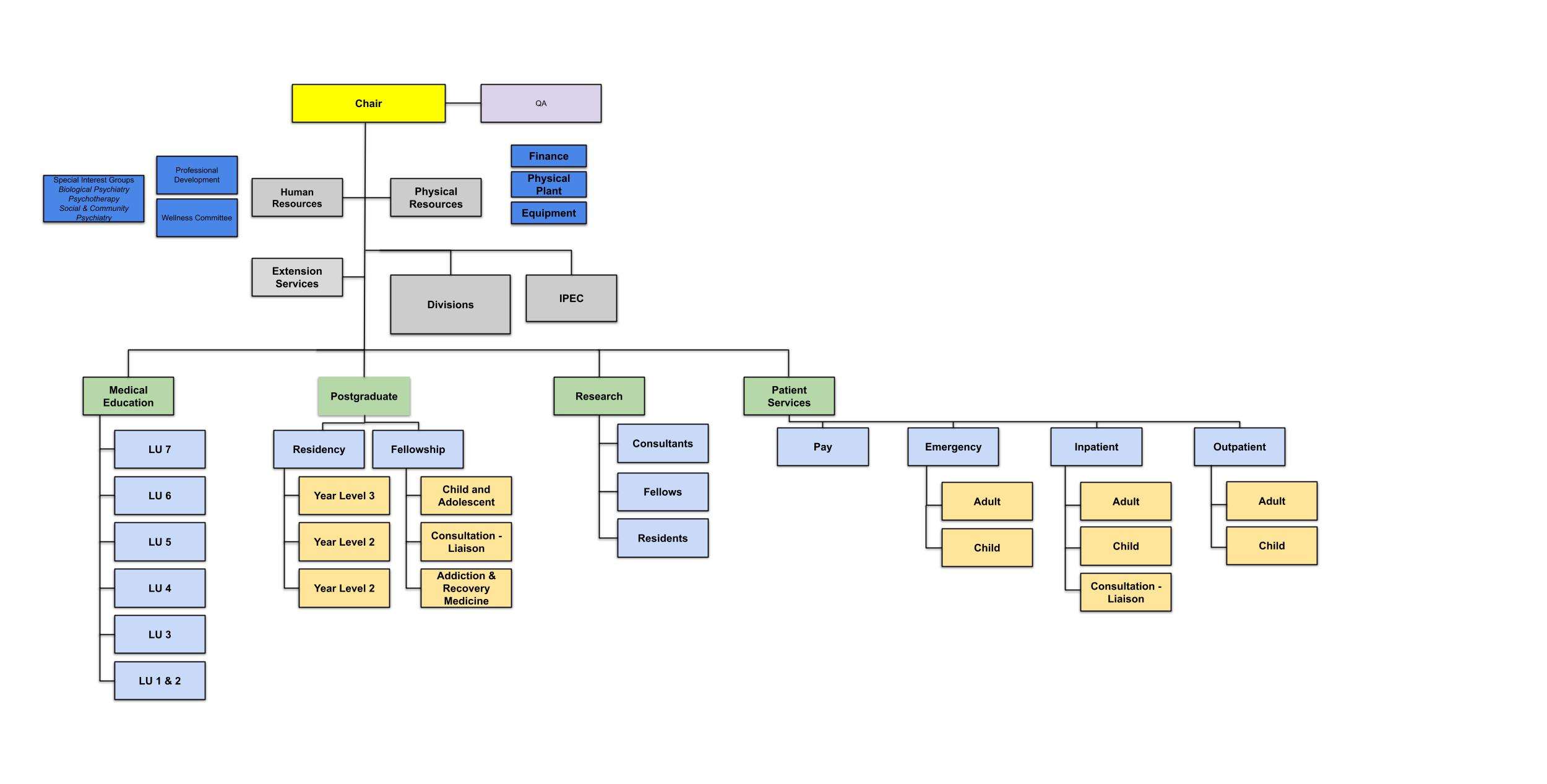
Several subspecialty divisions were formed as the expertise of the Department’s faculty grew. In 1978, Dr. Cornelio G. Banaag Jr. established the Division of Child and Adolescent Psychiatry, and three years later, the department began offering the first child and adolescent psychiatry fellowship training program in the Philippines. In 1989, Dr. Lourdes L. Ignacio established the Division of Social and Community Psychiatry, introducing the first social and community psychiatry fellowship program in the Philippines. In 1991, the Division of Consultation-Liaison Psychiatry was formed, with Dr. Jercyl Demeterio as its first head, and three years later, the department launched the first consultation-liaison psychiatry fellowship program in the Philippines. In 2023, the Division of Addiction and Recovery Medicine was established, with Dr. Joselito C. Pascual as the division’s first chair, offering the first multidisciplinary addiction medicine program in the Philippine.
In 1992, the Department was renamed the Department of Psychiatry and Behavioral Medicine, reflecting its expanded focus beyond psychopathology.
Department Chairs
| 1964-1970 | Baltazar V. Reyes † |
| 1971-1977 | Lourdes Vera-Lapuz † |
| 1978-1980 | Lourdes Ladrido-Ignacio |
| 1981-1988 | Baltazar V. Reyes † |
| 1989-1991 | Antonio P. Perlas † |
| 1992-2000 | Cornelio G. Banaag, Jr./td> |
| 2001-2010 | Ma. Cynthia Reyes-Leynes † |
| 2010 | Margaret B. Querijero |
| 2011-2021 | Anselmo T. Tronco |
| 2022-present | Anselmo T. Tronco |
Learning Unit 1
IDC 191 – Introduction to Patient Care 1: Self-awareness
Direct-entrant students undergo group discussion activities that guide them through skills development of self-discovery, self-reflection, and self-monitoring.
IDC 192 – Introduction to Patient Care 2: Awareness of Others
Direct-entrant students undergo group discussion activities to develop their awareness of others and hone their interpersonal skills.
IDC 193 – Introduction to Patient Care 3: Psychodynamics of The Doctor-Patient Relationship (Learning Unit 2)
Direct-entrant students engage in lectures, demonstrations, and group discussions to enhance their patient interaction skills as future physicians.
Learning Unit 3
IDC 202 – Art of Medicine 3: The Making of a Physician
Medical students develop their self-awareness, teaching-learning skills, communication skills, and interviewing skills, in order to become caring, compassionate, and ethical physicians who are attuned not just to the individual’s disease but to the person as a whole.
Learning Unit 4
OS 211 – Human Disease and Treatment 1: Integration, Coordination, and Behavior
Medical students learn about the pathophysiology, symptomatology, diagnosis, prevention, and treatment principles of diseases affecting the nervous system, including psychiatric disorders.
Psych 220 – Interventions in Psychiatry I: Group Process (elective)
Medical students learn about how group processes are done, including facilitating and conducting group therapy practices such as debriefing.
Neurosc 250 – Integrated Clinical Clerkship I in Neurosciences
Medical students rotate in neurology, neurosurgery, and psychiatry outpatient clinics, to learn more about the diagnosis and management of neurologic and psychiatric disorders.
Psych 221 – Interventions in Psychiatry II: Medically Ill Ambulatory Care (elective)
Medical students learn more about the diagnosis, management, and supportive care of ambulatory medically ill patients with psychiatric problems.
Neurosc 251- Integrated Clinical Clerkship II in Neurosciences
Medical students participate in patient care activities that enhance the integration of their knowledge in neuroscience, neurosurgery, and psychiatry, and acquire fundamental technical skills in the diagnosis and treatment of common neurologic, neurosurgical, and psychiatric disorders in the hospital setting.
Psych 292 – Clinical Elective in Psychiatry (elective)
Medical students deepen their understanding of the biopsychosocial approach to patient care, focusing on the doctor-patient relationship and evaluation of the personal role in the healing process.
Psych 294 – Interventions in Psychiatry III (elective)
Medical students gain deeper insights into psychosocial interventions for special populations at risk.
Neurosc 260 – Internship in Neurology and Psychiatry
Medical interns participate in rotations through the neurology, neurosurgery, and psychiatry inpatient and outpatient settings to learn common neurologic and psychiatric disorders, in addition to the basics of neuropsychiatric treatment and referral.
Postgraduate
Residency Training in General Adult Psychiatry (3 years, full-time)
This is a three-year full-time residency training program that trains licensed general practitioner physicians to become general adult psychiatrists. Through practice-based learning, trainees are exposed to various psychiatric treatment settings (emergency, inpatient, outpatient), where they are able to consolidate during direct patient care interactions the theoretical knowledge they receive from didactics courses and supervision sessions. The types of cases the trainees are exposed to become more complex as they go further in their three-year training. Trainees are also exposed to various subspecialties of psychiatry (child and adolescent psychiatry, consultation-liaison psychiatry, addiction medicine, neuropsychiatry, geriatric psychiatry, forensic psychiatry, administrative psychiatry) during their rotations throughout their three-year training. Trainees undergo regular summative assessments (written exams, oral exams, Grand Rounds case presentations) throughout the training program.
Fellowship Training in Child and Adolescent Psychiatry (2 years, full-time)
This is a two-year, full-time post-residency training program that prepares general adult psychiatrists to specialize in child and adolescent psychiatry. Through practice-based learning, trainees engage in the clinical assessment and management of children and adolescents presenting with psychiatric and mental health concerns. In addition to attending didactic courses and gaining experience through direct patient care, trainees also familiarized with other aspects of child and adolescent psychiatry, such as consultation-liaison child psychiatry, forensic child psychiatry, and administrative child psychiatry. Additionally, trainees are expected to complete at least one research project and one liaison program (either with a school or community, or within the Philippine General Hospital).
Fellowship Training in Consultation-Liaison Psychiatry (2 years, full-time)
This is a two-year full-time post-residency training program that trains general adult psychiatrists to become subspecialists in consultation-liaison psychiatry. Through practice-based learning, trainees are exposed to clinical, research, and administrative activities in consultation psychiatry (ie. direct provision of psychiatric services for patients with comorbid medical conditions) and liaison psychiatry (ie. collaboration with other healthcare professionals in developing psychiatric and mental health services for patients, their support systems, and their healthcare team). Apart from establishing and managing liaison programs with different units of the Philippine General Hospital, trainees undergo regular summative assessments (case presentations and seminars), supervise and assist trainees in managing their liaison programs and consultation referrals, and are expected to have completed one-to-two research projects by the end of the training program.
Fellowship Training in Addiction and Recovery Medicine (2 years, full-time)
This is a two-year full-time post-residency training program designed to develop physicians into specialists in addiction and recovery medicine. Its distinctive approach emphasizes the extensive effects of addiction across various populations and settings; as such, the program welcomes trainees who have completed residency training in fields such as general adult psychiatry, family and community medicine, internal medicine, pediatrics, neurology, and emergency medicine. In addition to courses on the clinical assessment and management of substance and behavioral addictions, trainees engage in activities related to addiction prevention program development and health policy planning activities, as well as rotations at specialized facilities focusing on substance and behavioral addictions. Throughout their training, trainees also participate in summative evaluations and must complete at least one clinical research project and one community-focused research project.
Masters in Clinical Science in Psychiatry (2 years, part-time)
This is a two-year part-time training program offered only to residency and fellowship trainees of the Department of Psychiatry & Behavioral Medicine. Residency and fellowship trainees that have successfully completed one year of training may apply for the program. This program complements the psychiatry residency and fellowship training programs’ goals of producing competent clinicians; it aims to enhance trainees’ abilities in mental health education, research, and administration. Trainees are exposed to learning activities that tackle different perspectives of mental health beyond the clinical (ex. philosophy and social sciences, ethics), scientific writing and communication, pedagogy, population-based management and project management, and social and community mental health. Trainees are also expected to have completed a research project by the end of the training program.
Evangeline B. DELA FUENTE, MD
Chair
| Faculty Name | Degree | Rank | Email Address |
| ALIBUDBUD, Rowalt C. | MD, MHSS, FPPA | Associate Professor 2 (PT) | rcalibudbud@up.edu.ph |
| ANLACAN, Joseph P. | MD, FPPA | Assistant Professor 7 (PT) | jpanlacan@up.edu.ph |
| DE GUZMAN, Ma. Lourdes Rosanna E. | MD, MS Epi, FPPA (Life) | Associate Professor 7 (PT) | medeguzman@up.edu.ph |
| DELA FUENTE, Evangeline B. | MD, MHA, MHPEd, DrHPED | Professor 4 (FT) | ebdelafuente@up.edu.ph |
| DELLA, Constantine D. | MD, FPPA, DIFAPA | Professor 3 (PT) | cddella@up.edu.ph |
| DE LA LLANA, Victoria Patricia C. | MD, FPPA | Associate Professor 2 (PT) | vcdelallana1@up.edu.ph |
| GONZALES, Rommel V. | MD, MPM-HSD, FPPA | Associate Professor 3 (PT) | rvgonzales3@up.edu.ph |
| LY-USON, Josefina T. | MD, FPPA (Life) | Professor 3 (FT) | jtlyuson@up.edu.ph |
| QUIRING, Joffrey Sebastian E. | MD, EMSRHS, FPPA | Associate Professor 2 (PT) | jequiring@up.edu.ph |
| SIONZON, Michael P. | MD, FPPA | Associate Professor 2 (PT) | mpsionzon@up.edu.ph |
| YU CHUA, Constantine L. | OTRP, MD, MFMH, FPPA, FPSCAP | Associate Professor 2 (PT) | clyuchua@up.edu.ph |
| CRUZ, Eric George V. | MD, FPPA | Clinical Associate Professor (PT) | evcruz6@up.edu.ph |
| NEPOMUCENO, Maria Elena D. | MD, DPBP, FPPA, FPSCAP | Clinical Associate Professor (PT) | mdnepomuceno1@up.edu.ph |
| GAPUZ, Evelyn G. | MD, EMBA, FPPA, FPSCAP | Clinical Associate Professor (PT) | eggapuz@up.edu.ph |
| Cecilia Nelia Cortes Maramba | MD, MscID, MScCT, FPPS, FPIDSP, FPSECP | Professor 12 | ccmaramba@up.edu.ph |
| GORDOVEZ, Francis James A. | MD, PhD | Clinical Associate Professor (PT) | fagordovez@up.edu.ph |
| PASCUAL, Joselito C. | MD, MSc | Clinical Associate Professor (PT) | jcpascual3@up.edu.ph |
| IGNACIO, Lourdes L. | MD | Professor Emeritus | llignacio1@up.edu.ph |
RESEARCH CONTENT
Department of Pharmacology and Toxicology
UP College of Medicine
Tel. No.: (+632) 0000-0000